

The Top 5 Mistakes First-Time Home Buyers in Las Vegas Make
The 2026 Las Vegas real estate landscape presents a normalizing market characterized by climbing inventory, stabilized mortgage rates, and sustained migration from high-tax states like California, New York, and Washington. For those entering this environment, particularly first-time home buyers in Las Vegas, the stakes are exceptionally high. Transitioning from renting to owning, or relocating to establish a primary residence in Nevada, requires more than a cursory understanding of property aesthetics. It demands a rigorous, data-driven approach. At The Batchelor/Hanna Group, we have analyzed the transaction data across our extensive career sales volume. We consistently observe the same structural errors made by unrepresented or poorly advised buyers. This analysis details the critical missteps first-time home buyers in Las Vegas make and outlines how we navigate the purchasing process to protect our clients’ capital.
Understanding the macroeconomic factors at play is the first step toward a successful acquisition. The Las Vegas Valley is no longer the highly volatile market of previous decades. It has matured into a robust economic hub with diversified industries. However, this maturation means that purchasing a home here requires sophisticated financial modeling and strategic foresight.
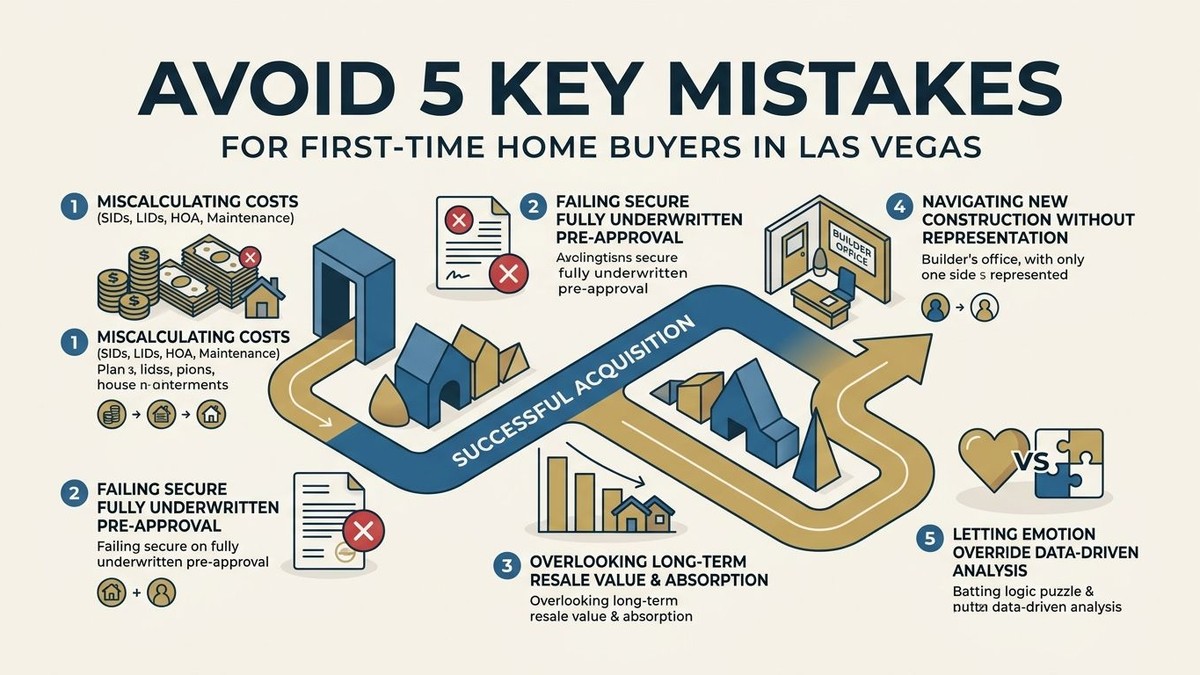
Mistake 1: Miscalculating the True Cost of Acquisition and Ownership
Many first-time home buyers in Las Vegas focus exclusively on the top-line purchase price and the resulting monthly mortgage principal and interest. This narrow view ignores the comprehensive cost of capital and ongoing carrying costs associated with property ownership. In premium markets such as Summerlin and Henderson, buyers must account for a variety of localized expenses that directly impact monthly liquidity.
For instance, many master-planned communities carry special assessment taxes, commonly known as Special Improvement Districts (SIDs) or Local Improvement Districts (LIDs), which fund public infrastructure. Furthermore, tiered Homeowners Association fees are standard across the valley. Purchasing within a guard-gated community involves monthly dues that fund premium amenities, security infrastructure, and landscape maintenance. Failing to factor these variables into your debt-to-income ratio can severely compromise your long-term financial stability. We advise our clients to model a complete financial picture that includes closing costs, property taxes, insurance premiums, and a capital expenditure reserve for future maintenance.
Mistake 2: Failing to Secure Fully Underwritten Pre-Approval
In a market where inventory is climbing but premium properties still command competitive attention, a standard pre-qualification letter is entirely insufficient. Pre-qualification is merely a surface-level review of stated income. A fully underwritten pre-approval means a lender has rigorously verified your tax returns, bank statements, and credit history before you even submit an offer on a property.
When we present an offer on behalf of first-time home buyers in Las Vegas, we leverage this fully underwritten status to signal absolute financial certainty to the seller. This strategic positioning often allows us to negotiate more favorable terms, even if we are not presenting the highest absolute bid. Sellers and their listing agents prioritize closing certainty over speculative premiums. By completing the underwriting process upfront, you also protect your earnest money deposit by eliminating financing contingencies that could otherwise derail the transaction late in the escrow period.
Mistake 3: Overlooking Long-Term Resale Value and Absorption Rates
Real estate is inherently an illiquid asset class. Purchasing a home without analyzing its future exit strategy is a critical error that many first-time home buyers in Las Vegas make. Buyers often fall in love with highly customized properties or homes located in hyper-niche neighborhoods that lack broad market appeal. We evaluate properties based on hard metrics, specifically absorption rates and inventory months.
If a specific sub-market in Southwest Las Vegas has a six-month supply of inventory, it indicates a balanced market. If that metric stretches to nine months, it signals a buyer’s market where future resale might require aggressive pricing adjustments. We guide our clients to invest in properties with strong historical appreciation, optimal price per square foot metrics, and proximity to high-demand infrastructure. This ensures the asset remains liquid when it is time to upgrade or relocate. For a deeper dive into how these metrics shape current valuations, we recommend reviewing our comprehensive 2026 Las Vegas real estate market update.
Mistake 4: Navigating New Construction Without Independent Representation
The Las Vegas Valley continues to expand with significant new development in areas like Skye Canyon, Inspirada, and the western edges of Summerlin. A common misconception among first-time home buyers in Las Vegas is that purchasing directly from the builder’s sales office will result in a financial discount. The reality is that the sales representative works exclusively for the developer, carrying a fiduciary duty to maximize the builder’s profit margin.
When buyers proceed without representation, they forfeit their leverage in negotiating lot premiums, design center upgrades, and closing cost incentives. Furthermore, builder contracts are heavily skewed to protect the developer. We strongly recommend securing independent representation for new construction to ensure your interests are protected, contracts are thoroughly reviewed, and construction milestones are independently verified by third-party inspectors. To understand this dynamic further, you can read our detailed analysis on securing independent representation for new construction.
Mistake 5: Letting Emotion Override Data-Driven Market Analysis
The most detrimental mistake any buyer can make is allowing emotional attachment to dictate their negotiation strategy. When a buyer becomes fixated on a specific property due to staging or cosmetic appeal, they often ignore the median price per square foot for the immediate neighborhood. This leads to overpaying, which creates immediate negative equity and complicates future appraisals.
If a property does not appraise for the contracted purchase price, the buyer is forced to cover the appraisal gap with out-of-pocket cash or risk losing the property entirely. Our methodology relies entirely on empirical data. We provide our clients with a comprehensive comparative market analysis before drafting any offer. We analyze recent closed sales, active competition, and the seller’s days on market to determine the precise fair market value. If the data does not support the asking price, we advise our clients to walk away. There is always another property that aligns with both lifestyle requirements and sound financial principles.
The Importance of Strategic Timing and Market Positioning
Beyond the specific transaction mechanics, first-time home buyers in Las Vegas must also consider the broader timeline of their purchase. Attempting to time the market perfectly is a flawed strategy. Instead, we focus on market positioning. This involves understanding seasonal inventory fluctuations and identifying micro-markets where buyer demand is temporarily subdued.
By analyzing year-over-year pricing trends and current absorption rates, we identify windows of opportunity where our clients possess maximum negotiation leverage. Whether we are targeting a single-family residence in Providence or exploring entry-level luxury options in Green Valley, our approach remains consistent. We utilize data to dictate the timeline, ensuring our clients enter the market when conditions align with their specific financial parameters.
How We Protect First-Time Home Buyers in Las Vegas
Navigating the complexities of the Las Vegas housing market requires a sophisticated understanding of economic trends, inventory metrics, and hyper-local neighborhood dynamics. For first-time home buyers in Las Vegas, partnering with an experienced advisory team is the most effective way to mitigate risk and secure a sound investment. The Batchelor/Hanna Group leverages extensive market research, a database of over 90,000 contacts, and a vast professional network to position our clients for success.
We do not rely on high-pressure sales tactics or emotional appeals. Instead, we present the data, outline the strategic implications, and execute a precise acquisition plan. We invite you to explore our strategic guide for first-time buyers to further prepare for your real estate acquisition. By prioritizing data over emotion and strategy over speculation, we ensure your first home purchase is a calculated step toward long-term wealth accumulation. For additional insights into the foundational steps of acquiring property in our market, you can also read our local guide to purchasing your initial property.