
The landscape of luxury real estate in Southern Nevada has undergone a fundamental transformation. As we analyze the migration patterns of high-net-worth individuals in 2026, the data reveals a sustained acceleration of buyers relocating from high-tax jurisdictions like California, New York, and Washington. For those considering moving to Las Vegas, the decision is rarely driven by emotion alone. Instead, it is a calculated wealth preservation and lifestyle optimization strategy.
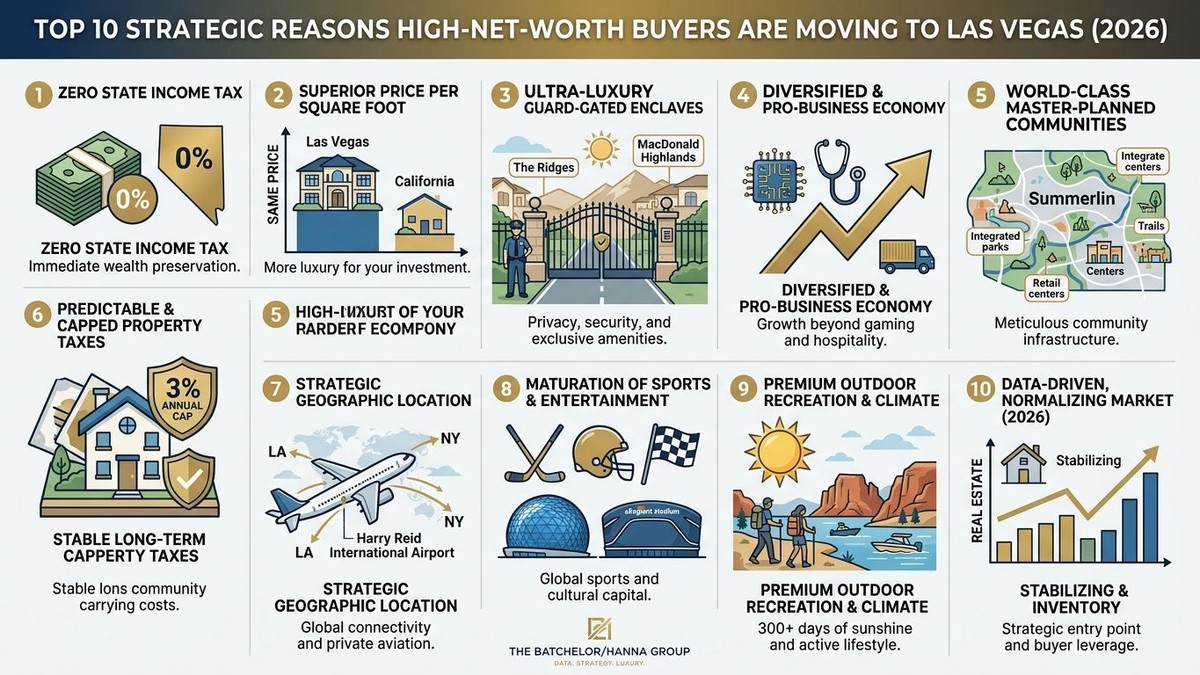
At The Batchelor/Hanna Group, we track the precise metrics driving this migration. We look beyond the surface-level appeal to understand the economic drivers, inventory metrics, and absorption rates that dictate market leverage. The current 2026 market reality presents a normalizing environment with climbing inventory and stabilized mortgage rates, creating a strategic window for affluent investors. Here is our analytical breakdown of the top ten reasons affluent buyers are moving to Las Vegas.
Table of Contents
1. Moving to Las Vegas for the Zero State Income Tax Advantage
The primary catalyst for wealth migration remains Nevada’s favorable tax infrastructure. When moving to Las Vegas, high-net-worth individuals immediately benefit from the absence of state income tax. For executives and business owners relocating from California or New York, this translates to an immediate retention of capital that would otherwise be lost to state levies. We consistently see clients reallocate these tax savings directly into their real estate acquisitions, allowing them to purchase significantly more property than their previous markets would allow.
Furthermore, Nevada does not levy corporate income taxes or franchise taxes, making it a strategic domicile for enterprise operations and family offices. This structural advantage provides a measurable, year-over-year return on investment simply by changing residency, a metric that heavily influences the decision-making process of our analytical buyers.
2. Superior Price Per Square Foot in the Luxury Tier
While the Las Vegas market has appreciated over the last decade, the relative value proposition remains highly competitive. Analyzing the median price per square foot in the $1.5 million and above tier reveals a stark contrast when compared to coastal markets. Buyers moving to Las Vegas from Los Angeles or San Francisco often find that their purchasing power doubles or triples.
A custom estate that commands $15 million in Southern California can frequently be replicated in Las Vegas for a fraction of that cost. This arbitrage opportunity allows our clients to upgrade their standard of living, acquire larger lot sizes, and secure premium architectural finishes while simultaneously reducing their overall housing expenditure. The data clearly supports Las Vegas as a superior market for luxury real estate capital allocation.
3. The Expansion of Ultra-Luxury Guard-Gated Enclaves
Security, privacy, and architectural excellence are non-negotiable for our clientele. Las Vegas has responded to this demand by developing some of the most secure and amenitized neighborhoods in the country. Communities such as The Ridges in Summerlin, MacDonald Highlands in Henderson, and Ascaya offer double-gated security, private golf courses, and elevated topography that provides unobstructed views of the Las Vegas Strip.
For a deeper understanding of the infrastructure and valuations within these neighborhoods, we recommend reviewing our analysis of exclusive guard-gated communities in Las Vegas. These enclaves are specifically engineered to meet the exacting standards of luxury buyers, offering a level of exclusivity and community planning that is difficult to find in denser urban environments.
4. A Diversified and Pro-Business Economic Climate
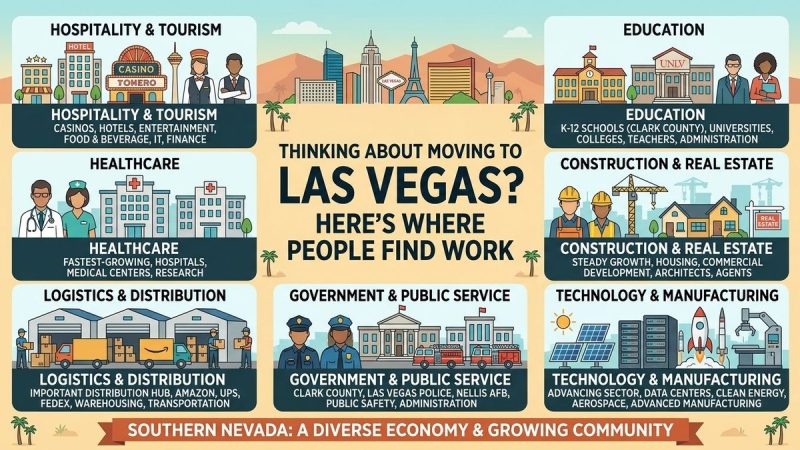
The narrative that Las Vegas is solely a gaming and hospitality town is entirely outdated in 2026. We are tracking a massive influx of corporate relocations across the technology, medical, and logistics sectors. This economic diversification creates a robust foundation for long-term real estate appreciation.
Business owners moving to Las Vegas find a regulatory environment that encourages growth rather than stifling it. The state offers various incentives for job creation and capital investment. This macro-economic stability provides our investors with the confidence that their real estate assets are supported by a multifaceted and expanding local economy, insulating their investments from sector-specific downturns.
5. World-Class Master-Planned Community Infrastructure
The architectural planning of the Las Vegas Valley is a significant draw for out-of-state buyers. Master-planned communities here are meticulously designed to integrate residential living with premium retail, dining, and educational facilities. Summerlin, for instance, spans over 22,000 acres and operates almost as an independent luxury municipality.
Those interested in the specific metrics of this area can explore our insights on the Summerlin luxury real estate market. These master plans ensure that property values are protected through strict zoning and community standards. The integration of parks, trail systems, and commercial centers creates a cohesive living experience that appeals directly to affluent families and executives.
6. Predictable and Capped Property Tax Rates
Beyond the lack of state income tax, Nevada offers a highly advantageous property tax structure. State law mandates a depreciation factor on the replacement cost of improvements, and more importantly, caps the annual increase in property tax bills. For primary residences, the property tax bill cannot increase by more than three percent annually, regardless of how much the market value of the home appreciates.
This legislative cap provides our clients with long-term carrying cost predictability. This is a stark contrast to jurisdictions where reassessments can trigger sudden and severe tax liabilities. When we model the ten-year holding costs for our clients, this property tax cap consistently emerges as a major financial advantage.
7. Strategic Geographic Location and Global Connectivity
For executives who must maintain a presence in multiple cities, logistics are paramount. Las Vegas offers unparalleled connectivity. Harry Reid International Airport provides direct flights to major global hubs, while Henderson Executive Airport caters specifically to private aviation, allowing for discreet and efficient travel.
The geographic proximity to Southern California allows for a brief forty-five-minute flight to Los Angeles. This connectivity is a primary reason why many business leaders are moving to Las Vegas. It allows them to establish Nevada residency and enjoy the associated tax benefits while effortlessly commuting to coastal boardrooms when necessary.
8. The Maturation of Professional Sports and Entertainment
The evolution of Las Vegas into a global sports capital has a direct, measurable impact on luxury real estate valuations. The presence of the Las Vegas Raiders, the Vegas Golden Knights, Formula 1, and incoming athletics franchises has transformed the city’s cultural footprint. This maturation attracts a new demographic of affluent buyers, including professional athletes, team executives, and sports-adjacent investors.
The infrastructure developed to support these events, such as the Sphere and Allegiant Stadium, elevates the global prestige of the city. We track a direct correlation between the announcement of major sports infrastructure and localized appreciation in adjacent luxury markets, particularly in the South valley near Southern Highlands and Henderson.
9. Premium Outdoor Recreation and Climate
While the economic data drives the initial interest, the lifestyle metrics often finalize the transaction. Las Vegas offers over 300 days of sunshine annually, facilitating year-round outdoor recreation. Luxury communities are frequently situated at higher elevations, providing immediate access to the hiking trails of Red Rock Canyon National Conservation Area or the boating facilities at Lake Mead.
The integration of indoor-outdoor living spaces is a hallmark of Las Vegas luxury architecture. Custom homes frequently feature disappearing pocket doors that blend interior great rooms with expansive pool decks and outdoor kitchens. This environmental factor is a heavily weighted variable for buyers prioritizing health, wellness, and an active lifestyle.
10. A Normalizing, Data-Driven Housing Market in 2026
Finally, the current market dynamics present a strategic entry point. As we navigate 2026, we observe a normalizing market characterized by climbing inventory and stabilized mortgage rates. This environment shifts leverage back toward the buyer, allowing for more rigorous negotiations and thorough due diligence.
Absorption rates have moderated, meaning our clients have the time to identify assets that perfectly align with their portfolio requirements rather than rushing into compromised purchases. To understand these metrics in detail, we invite you to read our 2026 Las Vegas luxury real estate market analysis. The days of frantic, sight-unseen bidding wars have been replaced by calculated, data-backed acquisitions.
Strategic Implications for Your Relocation
The migration of wealth to Southern Nevada is not a temporary trend; it is a structural shift in the luxury real estate landscape. Moving to Las Vegas offers a unique convergence of tax optimization, architectural excellence, and economic stability. However, navigating this transition requires precise market intelligence and a sophisticated understanding of localized inventory.
At The Batchelor/Hanna Group, we leverage our database of over 90,000 contacts and our experience closing more than one billion dollars in sales to position our clients advantageously within this market. We rely on hard data, inventory metrics, and absorption rates to ensure that every acquisition serves as a robust vehicle for wealth preservation. For a complete overview of the logistics involved, please consult our comprehensive relocation handbook for high-end buyers.
If you are evaluating a relocation, we are prepared to provide the analytical framework necessary to execute your transition seamlessly. The data dictates the strategy, and we are here to ensure your real estate portfolio is optimized for the 2026 market reality.