
A Case Study on the Las Vegas Real Estate Evolution
Understanding the current housing market requires historical context. The Las Vegas real estate evolution spans more than five decades, transforming an isolated gaming destination into a globally recognized epicenter for high-net-worth investors and out-of-state relocations. Drawing upon our 54 years of continuous local presence and market observation, we present a definitive case study on how this valley has developed. Our analysis spans the initial expansion of master-planned communities, the strategic diversification of our local economy, and the localized metrics that determine long-term asset valuation in 2026.
Analyzing the Las Vegas Real Estate Evolution: Historical Market Foundations
To evaluate the modern landscape, we must look at the structural changes that defined our market’s trajectory over the last half-century. Decades ago, the geographical footprint of the Las Vegas Valley was highly concentrated. The primary economic drivers were limited to the immediate resort corridor and its adjacent downtown infrastructure. Real estate development followed a rudimentary grid pattern, largely disconnected from the comprehensive urban planning models seen today. By examining the Las Vegas real estate evolution over the past 54 years, we can track exactly how strategic infrastructure investments shifted population density toward the foothills, fundamentally changing where high-net-worth individuals choose to deploy their capital.
The Strategic Expansion of Summerlin: From Arid Desert to Luxury Epicenter
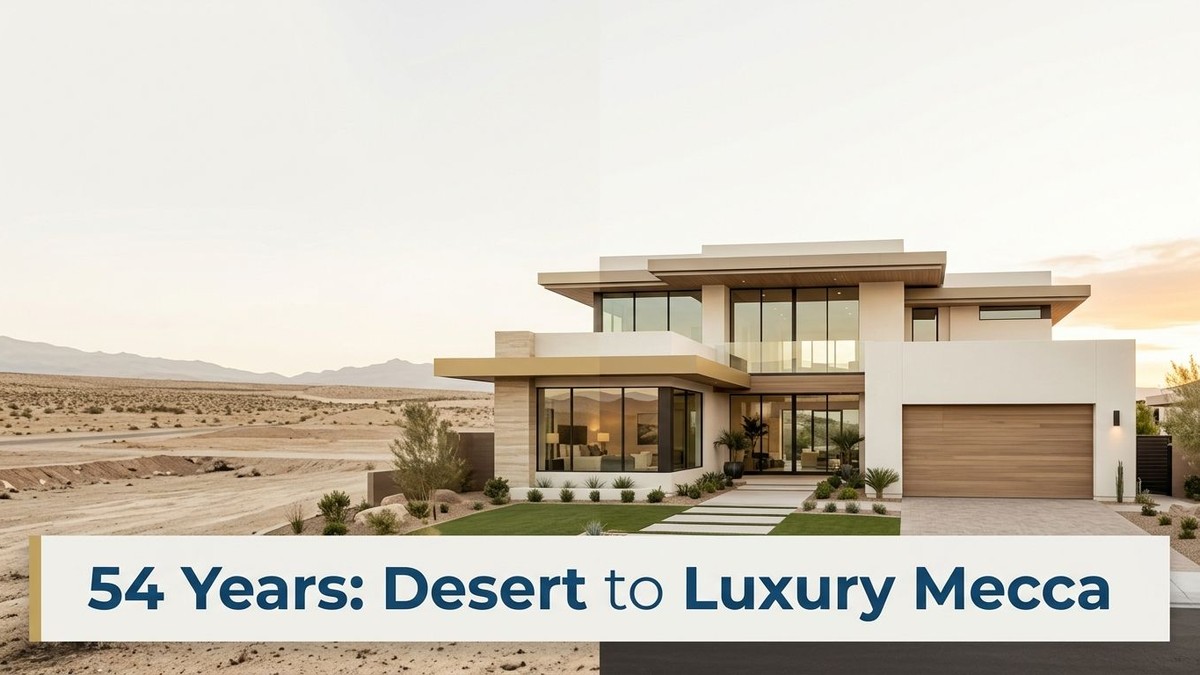
Perhaps the most significant metric in our long-term market analysis is the development of the western perimeter. When we review historical zoning maps from fifty years ago, the land that now comprises Summerlin was entirely undeveloped desert terrain. I remember when the city ended at Rainbow and watching the construction of the Summerlin Prkwy jetting out into the dessert like a road to no where! The vision orchestrated by the Howard Hughes Corporation initiated a profound shift in localized property valuations. Rather than building fragmented subdivisions, the developers instituted strict architectural guidelines, integrated commercial zones, and prioritized expansive green spaces.
Today, this area commands some of the highest price-per-square-foot metrics in Nevada. The transition from empty acreage to a premium residential enclave created an environment where Summerlin master-planned infrastructure heavily dictates market absorption rates. Buyers in the $2M+ tier consistently target the villages within this sector because the historical data proves that master-planned strictures preserve equity. By clustering premium amenities, private schools, and luxury retail alongside custom home sites, the western rim established a resilient micro-economy that consistently outperforms broader county averages during periods of macroeconomic normalization.
The Henderson Transformation: A Master Class in Urban Planning
Equally critical to understanding our region’s growth is the trajectory of our southern and eastern sectors. Historically, Henderson operated as an industrial, quiet municipality with minimal crossover into the luxury real estate conversation. Over the last several decades, strategic civic planning and targeted annexations transformed this once-sleepy town into one of the most desirable cities in the state.
The inflection point occurred when developers recognized the topographical advantages of the Black Mountain range. By terracing custom lots into the hillsides, builders created unparalleled sightlines of the valley floor. Communities such as MacDonald Highlands and Anthem Country Club redefined Henderson property valuations, establishing a benchmark for luxury living. Our data indicates that the migration of wealth from high-tax states heavily favors this jurisdiction due to its robust municipal services, lower localized tax burdens, and strict neighborhood governance. Henderson is no longer a secondary option for luxury buyers; it is a primary destination that commands rigorous bidding competition for prime view lots.
Economic Diversification: The Arrival of Professional Sports
A fundamental driver of recent property appreciation is the diversification of our macroeconomic base. For decades, the local economy relied almost entirely on gaming and hospitality. While those sectors remain vital, the integration of major professional sports franchises completely restructured institutional investment in the valley. The sequential arrival of the Vegas Golden Knights, the Las Vegas Raiders, the Las Vegas Aces, and the Formula 1 Grand Prix injected billions of dollars into commercial and residential real estate sectors. Soon to be adding the MLB stadium (Las Vegas A’s) and lot’s of talk around the upcoming NBA team!
This sports-driven economic expansion directly impacts luxury inventory. Executive personnel, professional athletes, and ancillary corporate sponsors require high-end, secure housing. This steady influx of affluent buyers tightens inventory in the $3M to $10M brackets. Furthermore, the global visibility brought by Formula 1 has attracted international investors who view our market as a stable repository for wealth. When assessing the future trajectory of our local housing market, the permanent infrastructure built to support these franchises guarantees sustained demand for premium residential properties.
Market Infrastructure: Navigating Traffic and Urban Transportation
As population density increases, transportation infrastructure becomes a defining variable in real estate valuation. Over 54 years, we have witnessed the transformation of local transit, most notably the completion of the 215 Beltway. This critical artery successfully decentralized the valley, allowing residents to bypass central congestion and commute efficiently between the master-planned communities of the west and the luxury enclaves of the south.
While traffic volume has undeniably multiplied since the late twentieth century, navigational efficiency remains surprisingly high compared to coastal metropolitan areas like Los Angeles or Seattle. The grid system engineered in the mid-century, combined with the strategic placement of the Beltway, ensures that affluent buyers can maintain rapid access to private aviation at Henderson Executive Airport or Harry Reid International without enduring severe gridlock. Commute times remain a strong selling point for out-of-state relocations.
The Local Perspective: Economic Engines Versus Residential Corridors
A common misconception among out-of-state buyers is the role of the resort corridor in daily life. From our extensive tenure in this market, the data and behavioral patterns are clear: locals almost never spend their daily lives on the Strip. The resort corridor is respected as the primary economic engine of the state, generating the tax revenue that allows Nevada to operate without a state income tax. However, it functions completely independent of the residential luxury experience.
High-net-worth individuals establish their primary residences in perimeter communities precisely to create distance from the tourist infrastructure. The geographical design of the Las Vegas Valley allows residents to enjoy Michelin-starred dining, luxury retail, and elite entertainment at local hubs like Downtown Summerlin or The District at Green Valley Ranch. This separation ensures that residential neighborhoods maintain tranquility, privacy, and low ambient noise levels while still benefiting from the economic advantages of living in a global tourist destination.
Historic Valuations: Neighborhoods That Consistently Hold Value
To protect capital, investors must identify neighborhoods with proven historical resilience. Over five decades of tracking absorption rates and median sales prices, clear patterns emerge regarding which communities retain their value through varied economic cycles. Early luxury developments like Spanish Trails and Spanish Hills set the initial standard for guard-gated exclusivity, maintaining steady valuations due to their central location and established landscaping.
However, the highest sustained equity growth is concentrated in modern enclaves that enforce rigorous architectural review boards and restrict inventory scaling. The Ridges/The Summit in Summerlin and Ascaya in Henderson represent the apex of this model. By strictly limiting the number of available custom lots and requiring contemporary, desert-modern architectural standards, these communities engineer scarcity. For a deeper analysis of these specific micro-markets, we routinely evaluate luxury guard-gated neighborhood performance to guide our clients toward assets that offer both immediate lifestyle benefits and long-term financial security.
Conclusion: Leveraging 54 Years of Market Intelligence
The evolution of the Las Vegas Valley from an isolated desert town to a premier global real estate market is backed by intentional civic planning, massive infrastructure investments, and a favorable tax environment. For high-net-worth buyers entering the 2026 market, understanding this historical trajectory is not merely an academic exercise; it is a critical component of risk mitigation. The communities that have flourished over the last half-century did so by design. By utilizing hard data, historical performance metrics, and our comprehensive local market knowledge, we position our clients to acquire properties that will continue to appreciate as this dynamic city moves into its next phase of economic expansion.